“Perfection is achieved, not when there is nothing more to add, but when there is nothing left to take away.”
~Â Antoine de Saint-Exupe
Paso Robles is smaller than I expected. It’s probably not much more than a mile from the north end of town to the south. It’s a quaint little town, and very bicycle friendly. I get a cozy homecoming sensation when I see my hotel, anticipating a warm shower and soft bed.
The young fellow behind the desk checking me in has a name tag that says “James,†and it turns he’s a cyclist. “Where’d ya ride from?†James asks.
I tell him my route from today, and he smiles and nods. “I’ve done that ride several times, over and back in a day. It’s a great ride, isn’t it?â€
Over and back in a day? That’s 150 miles, with steep climbing. This guy’s an animal. I’m tuckered out after doing just half the ride. I try to keep the wimp factor as low as possible when I reply. “Absolutely, a beautiful ride. I’ll bet it’s a sweet day going over and back in a day.â€
“Yeah, we usually ride over in the morning, have lunch at Lucia, then ride back after lunch. Steep coming up the Nacimiento Road, eh?â€
My eyebrows climb my forehead. “Steep doesn’t start to describe it! I thought I was gonna fall over a couple times.â€
His laugh is full of enjoyable nostalgia, his eyes looking off into the distance, as memories of what were probably wonderful rides wash over his face. Looking back at me, he asks, “So, where ya riding tomorrow?â€
“Tomorrow’s a really big day for me — I need to end up in Frazier Park.â€
I watch the joy of pleasant memories drain from his face, replaced by the agony of remembered pain. “I did that ride once. Hardest day I ever spent on a bicycle. Hell spread out over 150 miles. The winds across the valley spend the day sucking the soul out of you. Then the climb at the end of the day drops the hammer of ultimate despair on any joy left in whatever shell remains.â€
Uh, oh. I might have bitten off just a bit more than I can chew. James must have seen the look on my face, and tries to give me some encouragement. “But hey, maybe the winds won’t be bad for you, ya know? But either way, be sure and carry lots of water, because it’s a long way across that valley from here until you can fill your water bottles – something like 75 miles, right?â€
I’m not really feeling any better. “Right. Thanks. Yeah, 75 miles.â€
Falling back into his front desk persona, he continues, “You’re in room 327, Mr. Hanson. Be sure and let us know if we can get anything for you, and I hope you enjoy your stay with us. Oh, and good luck on your ride tomorrow!â€
“Thanks, I appreciate that. Oh, one other thing. James, is there a way I can package up a few things and have you ship them for me?â€
After a hot shower, I spread my stuff out on the bed. Sorting through it with more ruthlessness than I had back at home before I started the ride, I build a pile of “nice to have†items, ready to package up and ship back to Colorado. In the pile is my iPad, iPod, tiny speaker, Kindle, 700-lumen headlight, all the chargers associated with this electronic stuff, 4 of my tire tubes (leaving me still with 4), and a few other items. While I don’t put stuff on the scale, it seems to me that I’ve cut my weight in half.
When I packed for the trip, I wanted to stay under 20 pounds. I was able to do this while still including quite a few items that I might find handy. The iPad is only a couple pounds, the Kindle maybe a pound, the light a couple pounds. It all fit inside my 20 pound goal – why not take it?
My culture teaches that it’s good to have everything you might need. Having something is good, being without something is bad. When I was packing, my perspective was, “how much can I take, within my constraints?†Tonight, looking down at the gear spread out on the bed, I was asking myself, “how little do I need to survive?â€
Minimalism. Simplicity.
Stuff adds up if you’re not careful. It builds up around you. Getting rid of stuff brings a cleansing sensation. Almost like “stuff†weighs down the soul. It happens to me when I clean stuff out of my house too: a liberating sense, a lightness, after I go through and give away or toss large swaths of stuff.
When I was younger, I was more focused on accumulating than on distributing and cleansing. Now, I find myself constantly reevaluating just how much stuff I want around me. How much clutter can I tolerate before it weighs on my soul? How much flotsam am I willing to wade through to see the world around me clearly? It keeps me from moving along the path. Each “thing†I accumulate attaches a string deep into my heart and soul, connecting me to the thing itself, making continued movement down the path difficult. An addiction to accumulation maybe? A cultural epidemic?
My extra flotsam on this bike ride is one tiny symptom, but it’s all around us. Look at how much of our life’s energy we put into “accumulating wealth.†We advertise how much wealth we’ve accumulated with the homes we live in, the cars we drive, and our pride in our continued pursuit of greater wealth.
But all our wealth weighs us down. It’s too much to try and haul up the steep hills of the back roads of life. Instead, we stay on the flat and busy expanse of the masses, where we don’t need to confront the tough climbs that might be encountered in the wilderness of discovering ourselves.
The sweetest moments in life lay waiting along the steep and winding backroads, hidden among difficult questions and tough issues. Finding them sometimes requires sorting through deep and honest introspection. But these steep and meandering backroads might be one of the best places in life to find glimpses of heaven, and to discover what that means to each of us.
Learning minimalism. Wasn’t this a common message among the great sages of the last few thousand years? Who was it that so wisely said it was easier for a camel to pass through the eye of a needle than for a wealthy man to find heaven?
🙂
That’s on my mind this evening, as I look with satisfaction at the pile of “stuff†I’m sending back home. The last thing I want is seven or eight extra pounds in my bag that might slow me down if I catch a little glimpse of heaven somewhere along the road.
Pilgrim Wheels Excerpts This post is part of a series of posts, representing excerpts from Pilgrim Wheels, a story of a cycling journey across America. Pilgrim Wheels will be released in early March, let me know if you’re interested in doing an advance review.
“Mountains have a way of dealing with overconfidence.”
~Â Hermann Buhl
Reaching the detour route, I take a left onto Nacimiento Road, a forest service road that’s been paved. Crossing a cattle grate as I leave the highway, I begin a seven mile climb that combines heavenly views with hellacious climbing.
As the climbing begins, I drop into my lowest possible gear, and I’ll rarely leave that gear for the next hour and 20 minutes. The steep climb is about 3000 feet in about seven miles – about 400 feet a mile, an average of 7 to 8 percent. Maybe only 4 to 5 percent in some places, balanced by many places at 11 to 12 percent, a couple places at 16 to 18 percent. The U.S. interstate highway system allows a maximum grade of 6 percent. A 7 to 8 percent grade on a highway is considered dangerous; 9 percent is rarely encountered anywhere.
Pedaling up an 11 to 12 percent grade is gut-wrenching, even without the extra touring weight on the bike. At 16 percent, it’s all I can do to keep moving. The climb slaps some of the swagger right out of me, and has me giving serious consideration to those “nice to have†items in my pack. Tomorrow I have a VERY long day of riding, with climbing at the end of the day. Just how “nice†are those extra ounces and pounds I have in my pack?
While pouring my focus into the work of climbing, I also need to keep a little attention aimed at the road ahead and behind. For most of the climb, it would be impossible for two cars to pass each other at speed. The road’s just too narrow. When two cars pass, one needs to pull over as far as they can, while the other passes slowly. The constant tight turns and switchbacks limit the opportunity for even that sort of passing.
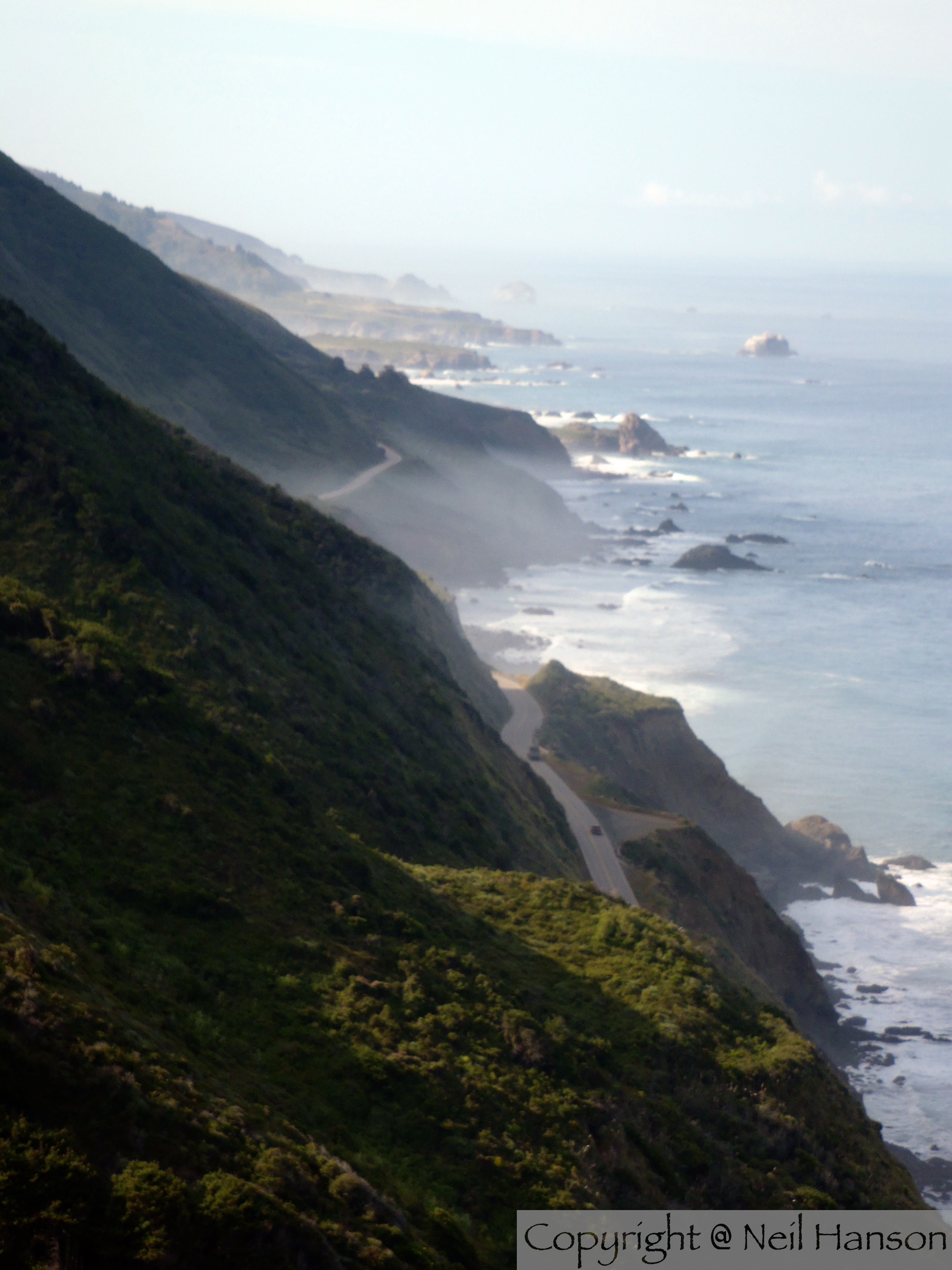
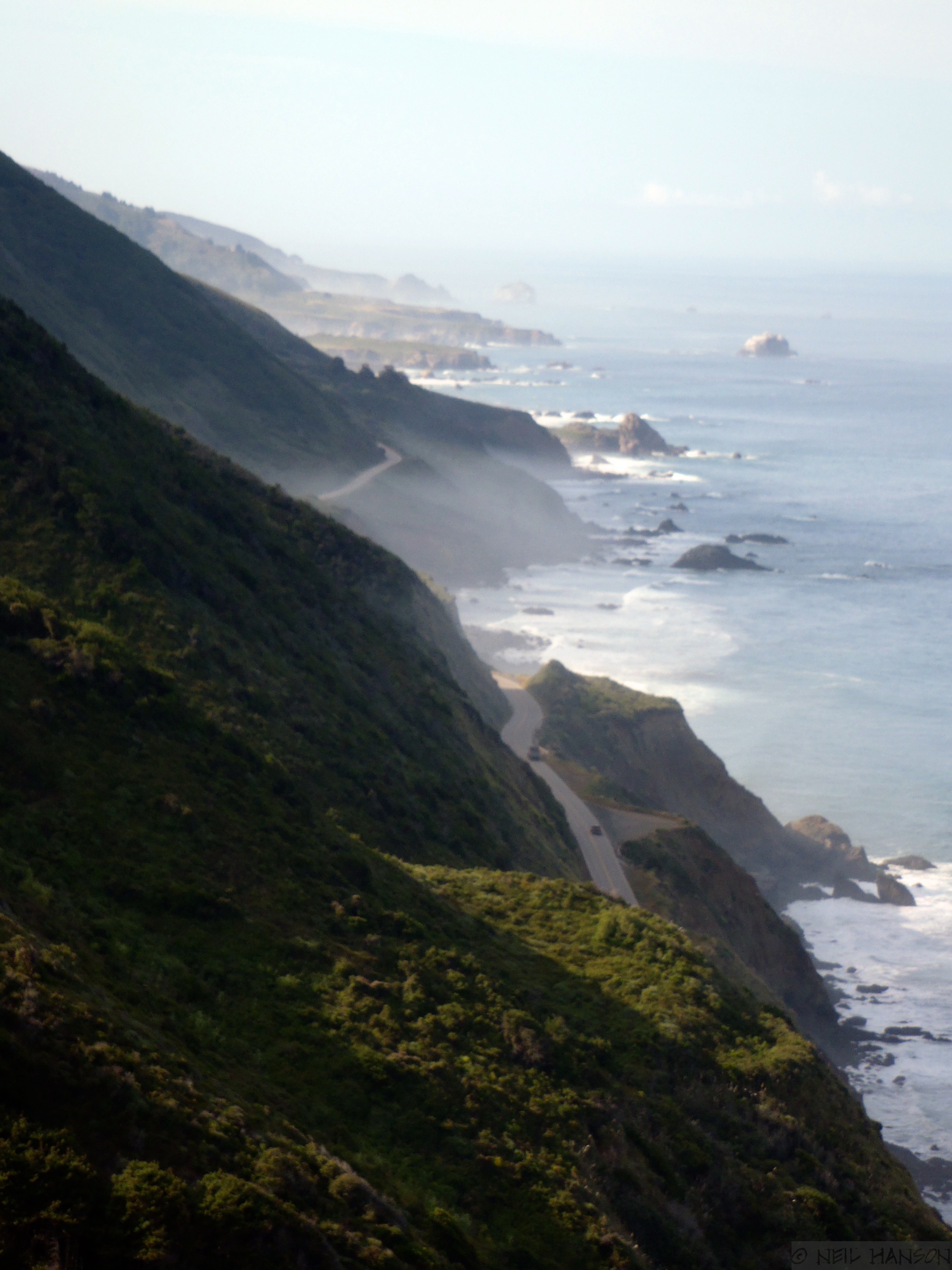
Notwithstanding the steep grade and narrow road, the beauty of the ride up the west slope of the Coastal Range is hard to express. The views back down onto the coast as I climb are stunning. Time after time, the road makes a sharp switch out on a ledge that gives me a view either north or south along the rugged coastline that takes my breath away. At one point, I’m stopped and admiring the view, eating a banana, when a convertible sports car steams past me headed up the hill. The driver is one of the blonde Beautiful People, sitting so low in the seat she can barely see over the hood. She waves at me as she passes, exclaiming, “Isn’t this just so beautiful?!â€
Well, yes it is. From the top of this bicycle, with an unlimited view and the time to take it all in safely, it’s beautiful indeed.
In those spots where the road tucks back into the mountainside, the landscape changes suddenly to a deeply forested thicket with towering redwoods. The transition from the openness of the mountainside to the depth of the thickets is usually marked by a zone of smaller trees covered in hanging lichens.
The grade gets much easier toward the top, but the temperature has dropped dramatically. I stop several times to enjoy wide vistas with views that seem to go forever back down the mountains and across the Pacific, but the stops are short as the moist air cools me rapidly. At the top of the climb, the road is deep into a forest, the air itself is quite cool, and I’m chilling down even faster. I stop, put on my jacket, and take in some fluid and calories.
Descending is downright cold, and I’m shivering hard. After a few miles of descending through forest, the landscape changes quickly and the temperature climbs. In less than five miles, I’m in a dry, grassy savannah much like my home on the eastern slope of the Rocky Mountains in Colorado.
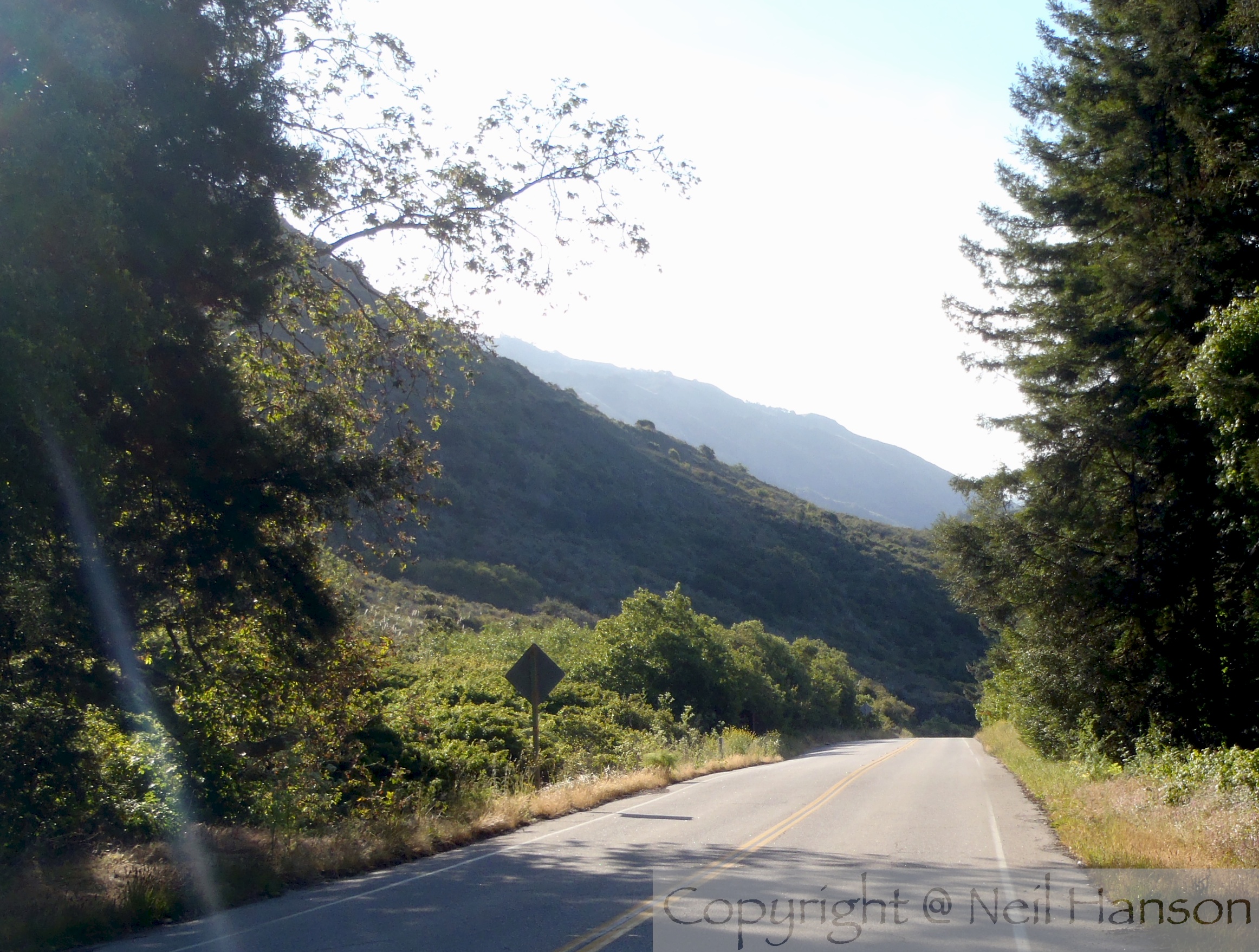
Nacimiento Road transitions into Fort Hunter-Liggett as the descent flattens out. The traffic is still extremely light, and I can only imagine how light the traffic would be without the road closure back on the coast. A warm tailwind follows me out of the mountains, painting a big smile across on my face.
Winding my way through broad oak savannah, I marvel at the massive old valley oaks spread thinly across the plain. Giant spreading trees, some of them 600 years old, they have massive trunks and beautifully shaped crowns. I stop to enjoy the silence and beauty of the place, leaning my bike against the side of one of these old Ents, and my back against the other side.
This old tree has called this grassy plain home for hundreds of years. Basking in the bright sun, soaking up nutrients from the ground, it’s grown to this nobility at a pace I can’t comprehend. It welcomes me under its shade, and I wonder what other folks looked like and sounded like who might have shared this shade in the past, over the hundreds of years that this old graybeard has been growing in this spot, quietly waiting for me.
I’m in Steinbeck country now, broad grassy pastures with scattered ancient trees. I imagine Samuel Hamilton jostling down the road toward me in a wagon, Lee sitting beside me in the shade. A small breeze whispers through the grass close to me as I lay against the old oak tree, a touch of sun making its way through the branches now and then to warm me, the sea of short prairie grass stretching out for several hundred yards between this tree and the next. Relaxation saturates my body as my mind brims with contentment. Soft savannah sounds fade into the distance as I doze up to the edge of a nap.
Pilgrim Wheels Excerpts This post is part of a series of posts, representing excerpts from Pilgrim Wheels, a story of a cycling journey across America. Pilgrim Wheels will be released in early March, let me know if you’re interested in doing an advance review.
A Bicycle Adventure Across The West: Day 3 – Lucia to Paso Robles
A Steep and Beautiful Climb Away From The Coast
“Mountains have a way of dealing with overconfidence.”  - Hermann Buhl
I’ve only got 70-something miles to go today, so I have another leisurely morning, enjoying breakfast. I know there’s a steep climb first thing out, but figure it can’t be that bad, and then the rest of the day should be easy.
Dave Meyers, (the fella I met the night before), is finishing up his early breakfast as I sit down, and he’s headed out for an early start on the day. We’ll both end up at Paso Robles tonight, so I could see him along the way. After a leisurely breakfast, I walk outside, hanging out and enjoying the beautiful morning.
A car pulls up with two young girls in it. They’re visiting from France, and apparently couldn’t afford the prices at the Inn, so decided to just sleep in their car. They look like their night’s sleep was not a good one, and I chat a bit with them before getting on the bike and heading down the road. I’m a couple miles down the road before it dawns on me that I should have offered them the use of my room to shower and rest. Of course, the folks who own the Lucia Lodge wouldn’t have been happy had they found out about it – they missed out on the chance to move a little more silver into their pocket. But the girls would have appreciated it I’m sure, and I could have bragged about the two pretty French girls who spent the morning in my hotel room. I would have left out the part about me not being there… Life’s about creating good stories…
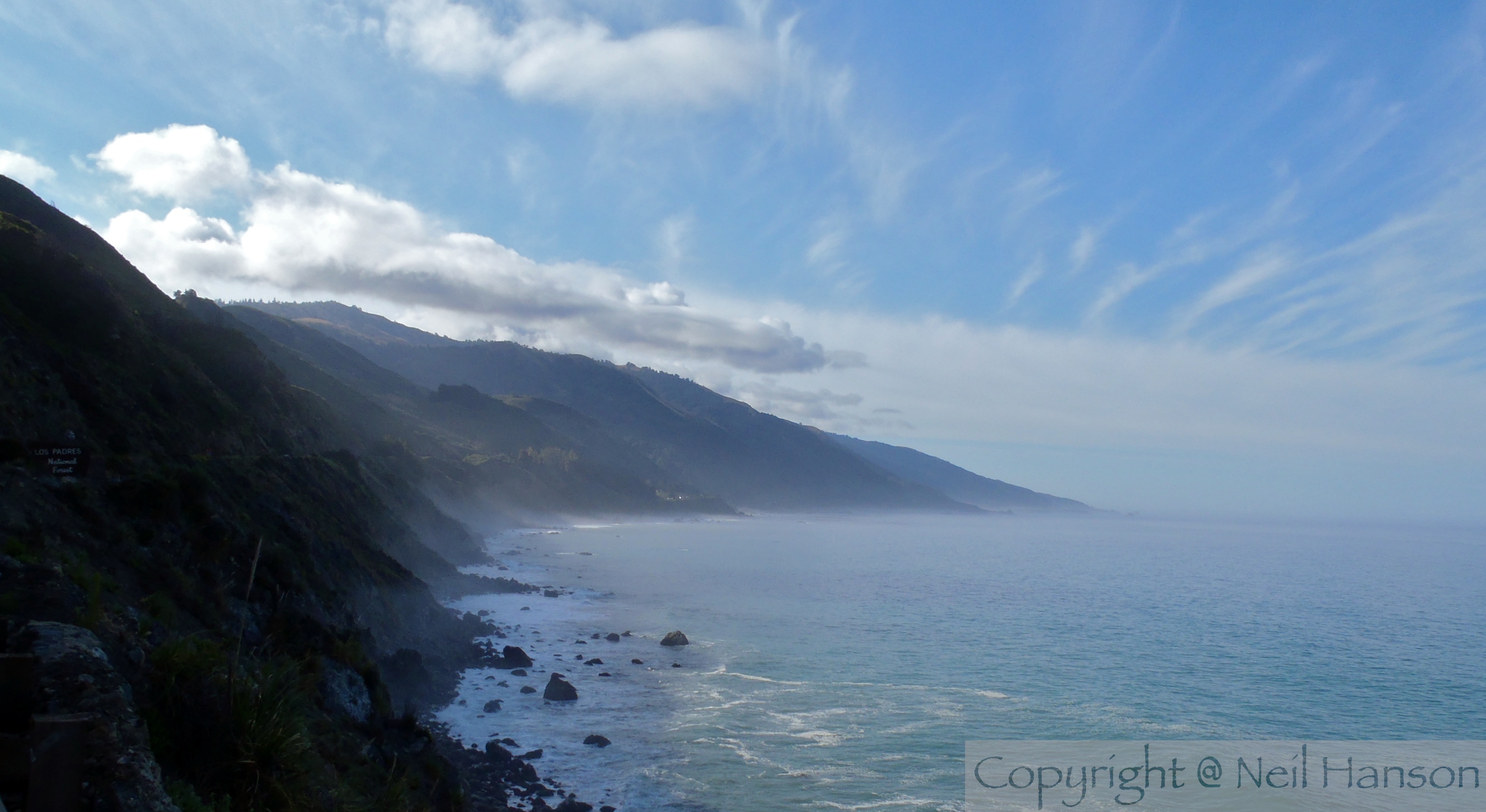
Headed south through Big Sur on the morning of Day 3
The first four miles follow the coastline up to the point where the road is closed, at which time I turn left, cross a cattle grate, and begin climbing on the Nacimiento Road. Those first four miles are really enjoyable, since there’s not a car on the road with the road closure. The morning air is cool and moist, and I savor the coastline, knowing this will be the last bit of riding I’ll get alongside it.
After crossing the cattle grate, I drop into my lowest possible gear, and will rarely leave that gear for the next hour and 20 minutes or so. I’d been told it was a steep climb, but hey, I live in Colorado and climb steep grades all the time. Such arrogance… The climb is a little under 3000 feet in about 7 miles – about 400 feet a mile, an average of 7% to 8%. A couple spots hit 16% and 18%.
Continuing to climb away from Big Sur - on a VERY STEEP road
That’s steep, and the extra weight I’ve packed isn’t helping at all during the climb. I stay lathered in a nice coat of sweat thanks to the hard work of climbing. I stop to take pictures a few times, but the chilly air gets me moving again quickly to stay warm.
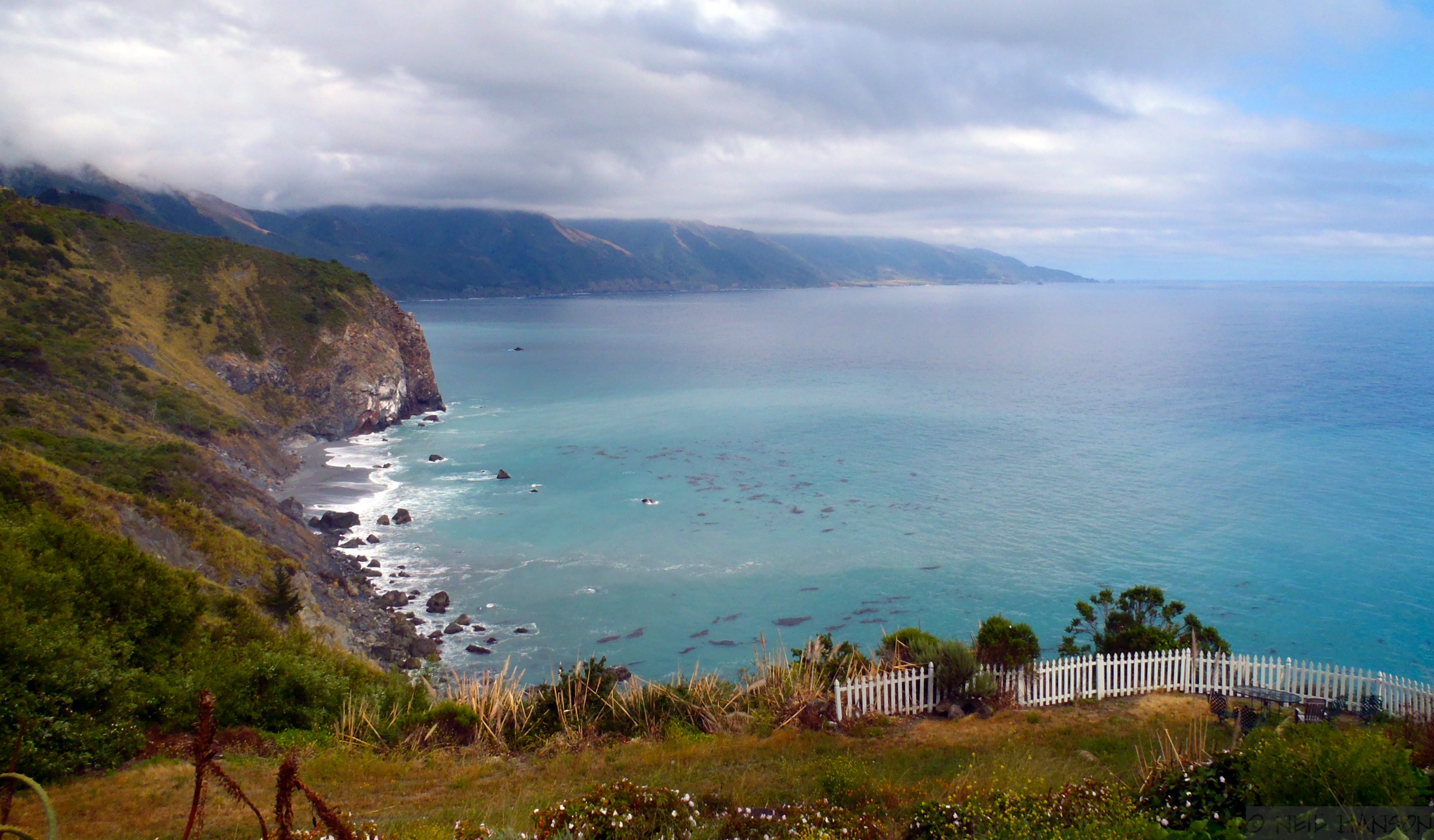
The road is really quite beautiful, and the views back down onto the coast from the steep mountainside are stunning. There are spots where you’re climbing through stands of towering Redwood, and other spots where you’re pedaling beneath lichen-covered branches that overhand the road. Mixed in are vistas with views that seem to go forever back down the mountains and across the Pacific.
Looking back north along Big Sur on the steep climb over the coastal range
As I’m climbing, the support van from the touring group I passed yesterday passes me. Turns out they’d sagged the cyclists up to the top of this steep climb, and the cyclists then rode from there to their next destination. I wave at them as they pass. Their route is slightly different from mine over the next few days, and I’ll get ahead of them and not see them again. By the time I get to Colorado, they’ll be about a week behind me.
At the summit of the climb, I put on my jacket and start a cold descent. The road twists and turns as it drops, and after about 10 minutes or so of shivering, I’ve descended into warmer air that’s noticeably more dry than the air on the other side of the mountain.
It’s amazing how quickly the landscape changes from one side of the coastal range to the other. On the wet side of the mountain, there were towering Redwoods and plants that were almost tropical. This dry side of the mountain, though, reminds me a lot of my home in Colorado, heavy with grasslands and pine.
Reaching the base of the descent, the road passes through the gate into Ft Hunter-Liggett. In normal times, the gate is manned, and you’ve got to show your drivers license and proof of insurance if you’re in a car. However, since highway 1 is closed, and traffic is diverted to this road, the gate isn’t manned, and I pass right through.
The base of one of the giant oak trees on the inland side of the coastal range in Ft Hunter-Liggett
Largely deserted, the highway is a beautiful ride through oak savanna. I believe the oak trees that are abundant along this ride are Valley Oaks. They’re giant trees, massive trunks and beautifully shaped crowns. These trees are up to 600 years old, and I stop and enjoy a little rest, leaning my bike and my back against one of these old ents, soaking up that ancient energy again.
Continuing along Nacimiento-Fergusson road to Mission Rd, I make my way through Ft Hunter-Liggett, eventually coming to what they call “the G-14â€. (An unusual language usage in this part of California is that people refer to roads like that – “the G-14â€, or “the 1â€, meaning highway 1.)
I head southeast along the G-14 into a headwind that’s a little frustrating. It’s not a heavy wind, but I’d had my expectations set for that NW wind that is supposed to be blowing this time of year. For much of the ride, the wind is very light, but at times, it gets between my ears and messes with me…
At Lockwood the road turns right. There’s really no town or anything else here, just a tiny store on the corner, and I stop and calorie-up a bit. As I’m sitting in the shade, I eavesdrop on a conversation some locals are having. A gal has gotten a new job with the county, and she’s telling her friends all about it. After they leave, I go over and talk to her, as I’m interested in what she does.
Turns out she catches bugs. I’m in wine country now, (though I haven’t really seen the evidence yet), and they go to great lengths to assure that certain particularly destructive bugs don’t make their way into their region. She goes around all day setting traps, and investigating what she catches. She’s really excited about her job and what she does, and tells me WAY more than I need or want to know about bugs. I politely tell her I’ve got to make my way down the road, and pedal off, leaving her making notes about bugs in her bug log.
Another 20 miles down the road is a little intersection called Bee Rock. I catch up with Dave Meyers here at Bee Rock, and we enjoy a sandwich together. Like Lockwood, there’s nothing here but a store. The store here is much friendlier than the one at Lockwood, with nice tables to sit at. Dave and I enjoy a nice long lunch here, chatting and enjoying the beautiful day. When I’m ready to leave, Dave isn’t quite ready, so I head up the road ahead of him.
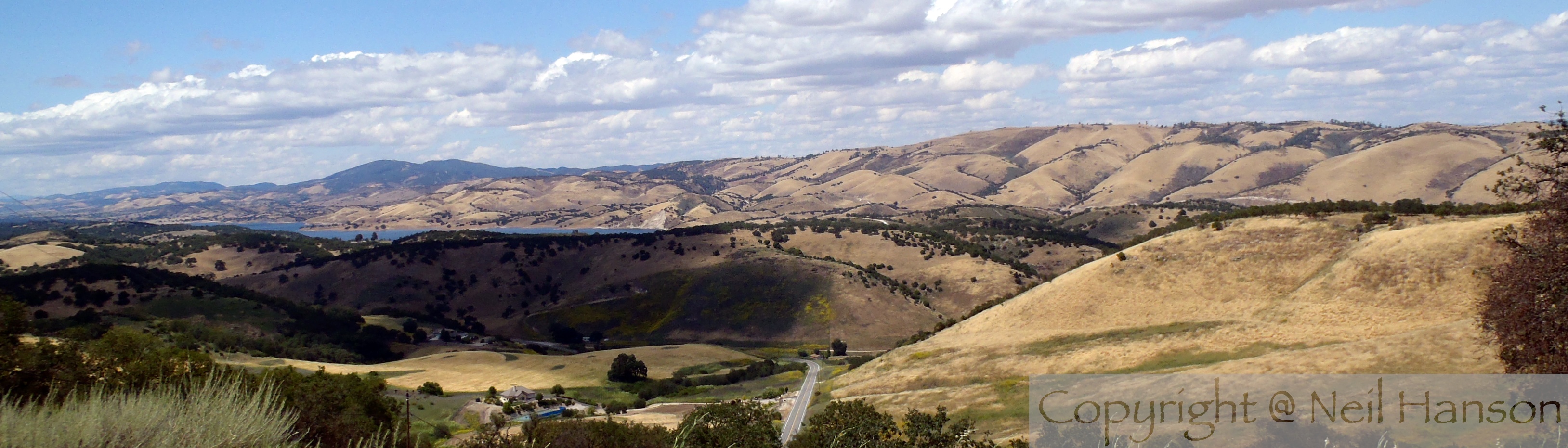
And up it is. For the first 2 or 3 miles out of Bee Rock, there’s a steep little climb that’s a bit of a surprise. My legs are toast after the climbing this morning, so they complain quite a bit headed up over this grade. At the top of the grade, though, there are beautiful views in most directions. Lake Nacimiento is off to the right, and Lake San Antonio is behind and off to the left.
The views after climbing south from Bee Rock
From here to Paso Robles, the road gets quite a bit busier, with steady rollers lasting a good bit of the way. The road has little or no shoulder in spots, making for a few nervous moments with cars and trucks squeezing me to the edge of the pavement. By the time I reach Paso Robles, the wind has turned a bit, and sometimes quarters at my back. Still a light wind, but anything not in my face is appreciated.
Paso Robles is a nice little town. I can easily see coming here for a little vacation. It’s quite bicycle-friendly, and smaller than I expected. It’s probably not much more than a mile from the north end of town to the south. It’s a warm “homecoming†sense I get when I see my hotel – a feeling that I’ll come to expect and look forward to at the end of each day. I know there’s a warm shower and a soft bed waiting for me.
Tonight, I’m using Marriott points and staying at The Courtyard in town. It’s a great little hotel, and the folks are quite friendly and helpful. After I get checked-in and showered-up, I spread my stuff out on the bed, and start sorting through to create my second package to send back home. The steep climb this morning, followed by rollers all afternoon, taught me a hard lesson (again) about weight. I send home my iPad, iPod, tiny speaker, Kindle, 700-lumen headlight, all the chargers associated with this electronic stuff, 3 or 4 of my tubes (leaving me still with 3 or 4), and probably a few other items. While I don’t put stuff on the scale, it seems to me that I’ve cut my weight in half with this package.
It’s a nice lesson to me on simplicity and minimalism. When I was packing for the trip, I remember laying everything out, and going through some dry-run packs. I’d thought about trying to bring the iPad with me – I’d even found a pretty strong case with a keyboard built-in – seemed like the perfect solution for somebody like me who likes to write when I have a little spare time. The iPad only weighs a couple pounds or so – not a big deal. And of course the Kindle was pretty small too, and weighed only half a pound or so.
In the end, I had in my mind that I wanted to stay under 20 pounds, and I was able to do this and still carry many of these items that I might find handy. It all fit – why not take it?
Sitting in my room in Paso Robles, after climbing during the day that felt much more brutal than it should have, I have my answer. My culture has taught me that it’s “good†to have everything you might need. Having something is good, being without something is bad. That’s the world-view from which I’ve developed my values and guiding principles.
So of course, the lens through which I’d been looking when I packed was one of “how much can I take, within my constraints?†Tonight, looking down at all my gear spread out on the bed, my lens has changed a bit. Now, I’m looking at my gear, and asking instead, “how little can I survive with?â€
It might seem like a small difference, but it makes a big difference in what gets packed. Frankly, it makes a big difference in how I look at every day of this trip I’m on. Tossing my iPod in the package to ship home, there’s no whisper in my ear asking me to consider, “but you might want to listen to podcasts or tunes…†I’m delighted to put as much into the package home as I can, with no regrets or “what if†second thoughts.
Climbing away from the Big Sur coastline
Getting rid of stuff is a cleansing sensation. Almost like “stuff†weighs down the soul. It happens to me when I clean stuff out of my house too – a liberating sense of “giving†and “lightness†happens after I go through and give away (or toss) large swaths of stuff.
I think it’s a “place in life†thing to some extent. When I was younger, I seemed more focused on “accumulating†than on “distributing and cleansingâ€. At the point I’m now at in life, I find myself constantly re-evaluating just how much “stuff†I want around me. Accumulated stuff is clutter and flotsam that I’ve got to wade through over and over again. It keeps me from moving along the path. It’s as though each “thing†I accumulate attaches a string deep into my heart and soul, connecting me to the thing itself, making continued movement down the path difficult.
Why do we do this? It feels like an addiction we’ve developed – an addiction to accumulation. This little tendency to take a little too much with me on a bike ride is one tiny symptom, but if I look at my culture at a much higher level, it seems we’ve built our entire civilization on the same addiction and sickness. Look at how much of our life’s energy we put into “accumulating wealthâ€. This is seen as a very good thing, this accumulation of wealth. We advertise how much wealth we’ve accumulated with the homes we live in, the cars we drive, and our pride in our continued pursuit of greater wealth.
We’ve accumulated so much wealth that there’s no way most of us would even attempt to climb the tough hills and mountains of the back roads of life. Instead, the vast majority of us stay on the flat and busy interstate highway system, where everyone else is. It’s just the way we live – stay on the well-traveled and flat expanse of “the bypassâ€, and you don’t need to confront the difficult climbs and rollers in life.
Continuing to climb away from Big Sur - on a VERY STEEP road
But that’s where the best life has to offer is – out there along the steep and windy backroads. The questions and issues are hard ones, and require deep and honest introspection, but the rewards are beyond words. I’m pretty sure that’s where we find the doorways to heaven – out there along those difficult backroads of life where the climbs are steep and the roads wind their way through tough questions.
Looking back to the great sages of the last few thousand years, I find that message loud and clear. I grew up in a Christian tradition, and Jesus was pretty clear when admonishing followers to avoid the temptation of accumulation of wealth. He instructed followers to leave all they owned behind if they wanted to become a disciple. Easier for a camel to pass through the eye of a needle, He said, than for a wealthy man to be able to find heaven.
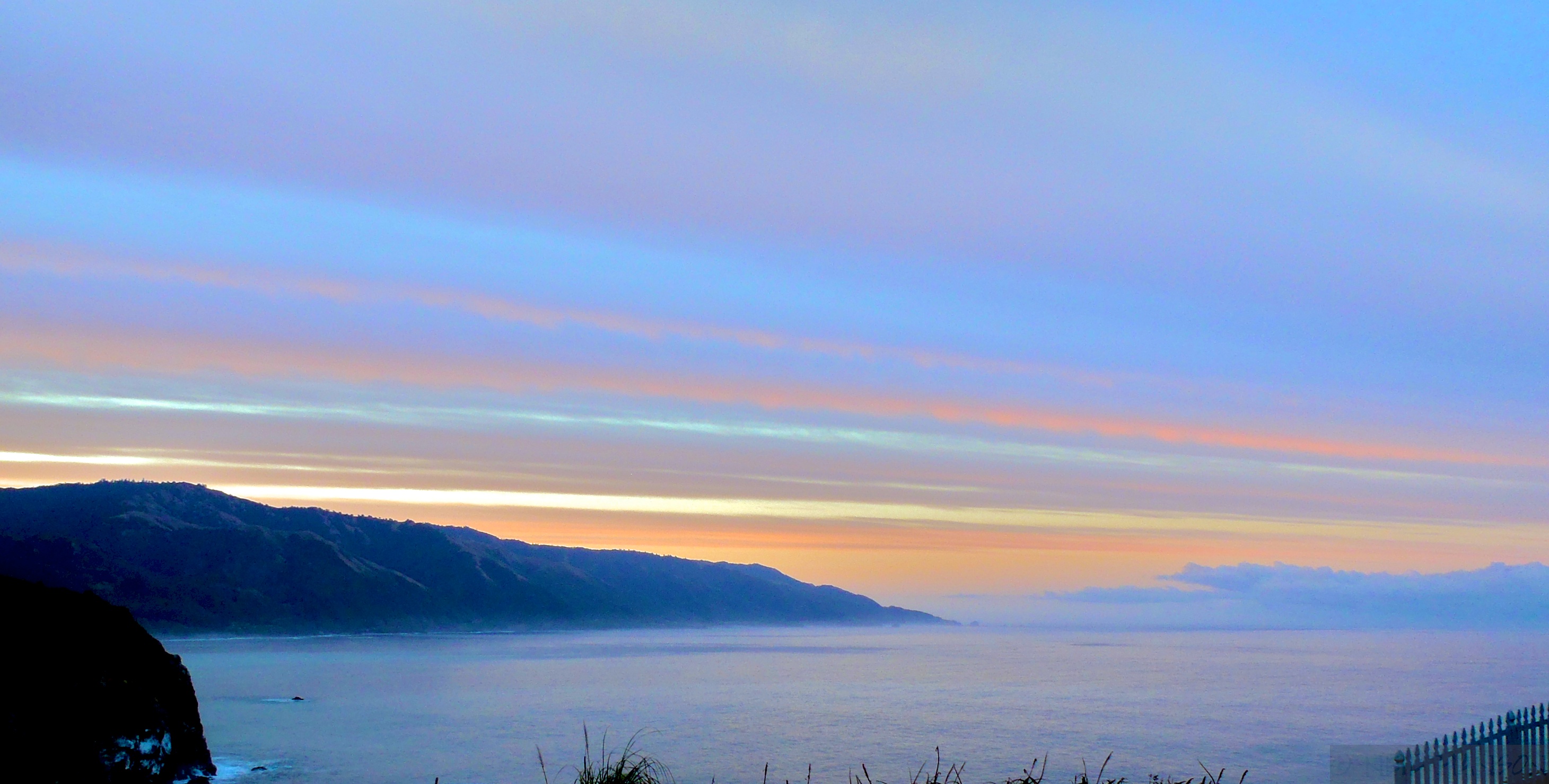
Morning along the Big Sur coastline
That’s on my mind this evening, as I look with satisfaction at the pile of “stuff†I’m sending back home. I’m grateful to have met Dave Meyers yesterday, as his inspiration gives me a bit more confidence in taking the drastic approach I’m taking. I don’t have any illusions of finding heaven on this trip, but the last thing I want is 7 or 8 extra pounds in my bag that might slow me down if I catch a little glimpse…
As soon as the land of any country has all become private property, the landlords, like all other men, love to reap where they never sowed, and demand a rent even for its natural produce. ~Adam Smith, Wealth of Nations
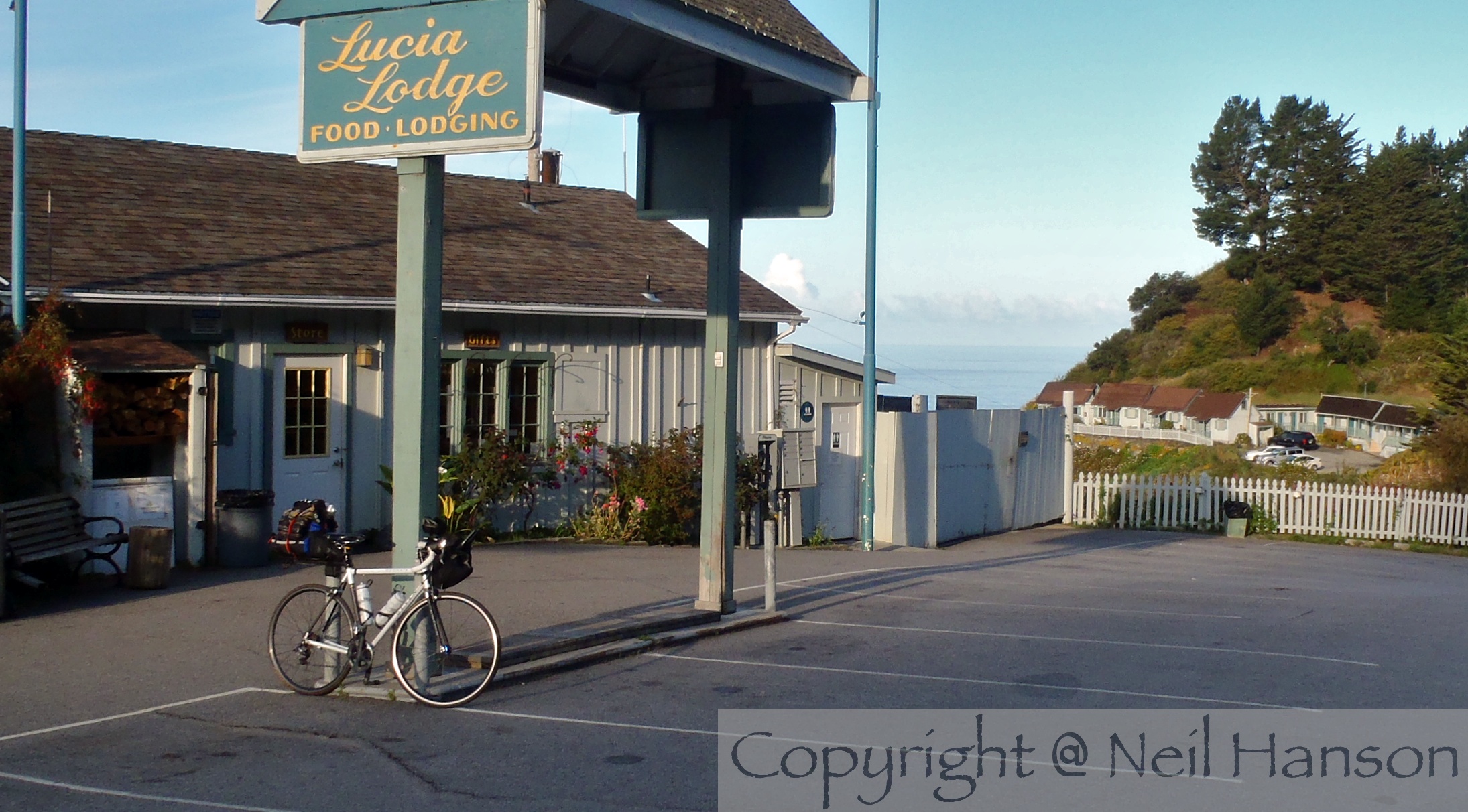
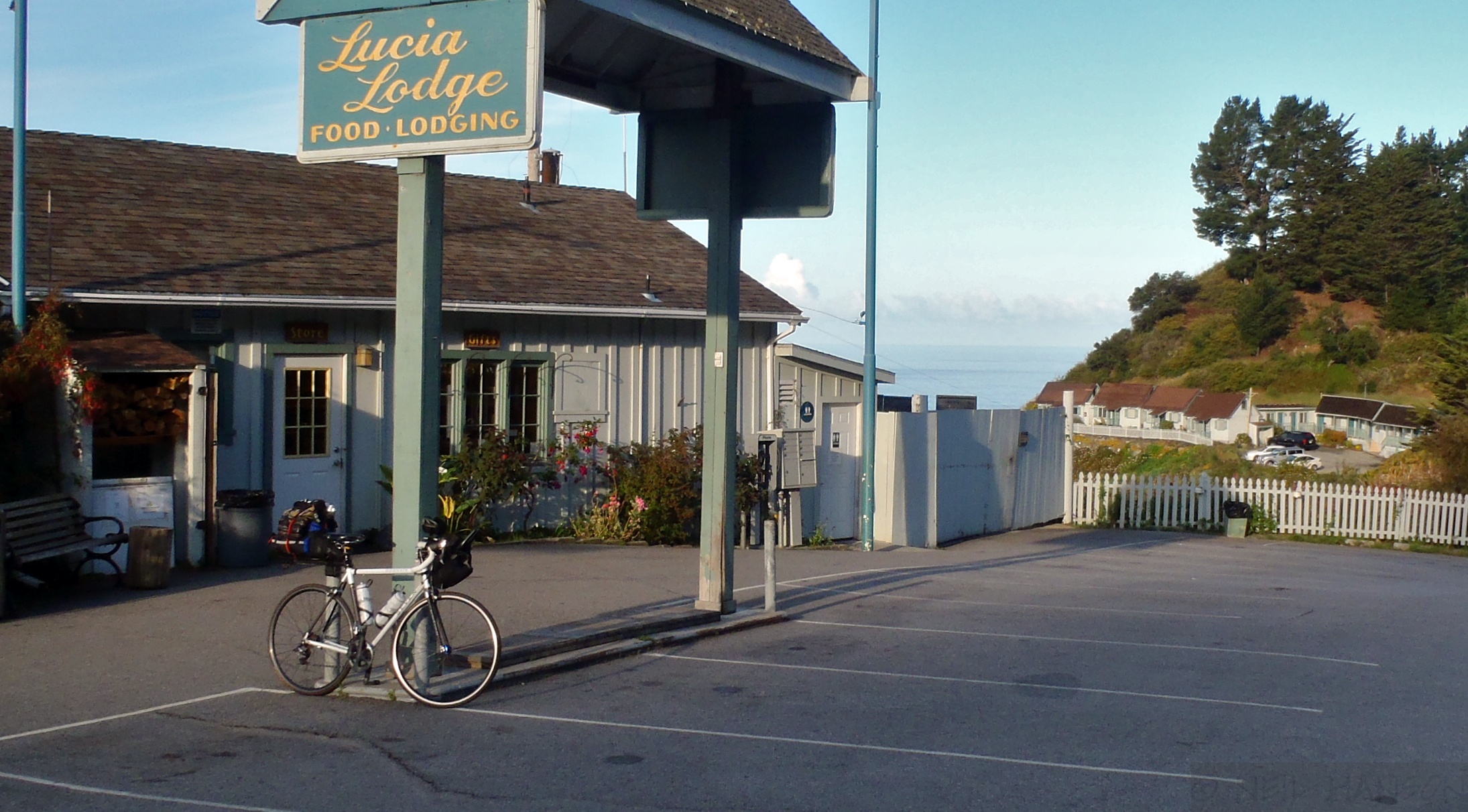
On my bicycle ride across the West this summer, I ended up in a little lodge along the coast at a place called Lucia. This was my second night out, and came at the end of a wonderful day of enjoying the Big Sur coastline.
While Lucia shows up as a town on some maps, it’s really not a town at all. It may have been an actual town in the past, but now all that’s there is a lodge and restaurant. Seems the property has been in the same family’s hands for several generations. They have a great spot – right on the coast – and they offer lodging and dining in a beautiful setting.
In many ways, it’s a shining example of free enterprise, the declination brought on by nepotism, and the arrogance and sense of entitlement that “ownership†inspires all wrapped into a single stop along the highway.
If you ignore price and attitude, and just look at the place, it’s a quaint little spot with a beautiful view. Of course, you’re in Big Sur, so it’s tough to find a spot along the highway that doesn’t have a beautiful view. The food in the restaurant is OK but certainly not great – about what you’d expect in a cafe along the highway. The rooms are tiny little things cut out of a strip-style building – quaint, quite small, and very old. The room I stay in is very run down with a pretty lousy bed and plumbing that not only doesn’t work right, but is in a state of “half-repairâ€. Whoever takes care of that sort of thing will finish the job when they get around to it.
But hey, that’s OK with me, my standards for motel rooms are extremely low. I’m usually happy to stay in a small-town motel that costs $35/night, knowing full-well that it’s gonna be just like this.
The problem is, this room is a couple hundred dollars a night. Really. And the meals are proportionately overpriced.
It’s the free market at work. This is the only lodge and dining along the highway for miles, and there will be a certain number of tourists that won’t have any choice but to pay those prices. Many will book online, with high expectations for the price, and will just have to live with disappointment. Their cancellation policy is quite strict – you can’t check-in until 3:00, but they don’t accept cancellations after 2:00. If you show up and are outraged at the price, you’re past the point you can cancel, and your card is charged, so you might as well stay.
I’m on vacation, and I’m OK with a reasonable fleecing now and again. So tonight, I’m getting fleeced – I might as well enjoy it. At least I’ve got a warm room to sleep in, and a beautiful view. The warm shower feels wonderful, though their wireless isn’t working, (sorry, no discount for that additional insult). I do a little writing, then walk up to the lodge for an early supper.
It’s warm and quaint in the cafe portion of the lodge. It’s less than half full – a highway closure has dramatically reduced the tourist traffic. A couple walks in, obviously looking around for a place to sit. I listen as the waitress asks them if they’re here for dinner, and they say they’re probably just going to sit and have coffee. They’re an older couple, with a Scandinavian accent. In keeping with their culture, they’re extremely polite as the waitress tells them they can get coffee at the general store next door, making it plain she doesn’t want them taking up dining room space if they’re only going to spend the price of coffee.
It seems everyone who works here is “part of the familyâ€. They’ve developed an arrogance over the years, and a sense of entitlement to use this little piece of paradise they “own†to take every possible penny from every possible traveler. They’ve been blessed with a wonderful place in a beautiful location, but their connection to this wonderful little corner of paradise has been twisted. They don’t seem to see it as a gift and blessing that also allows them to make a living. Instead, I get the feeling they see it as a cash cow to milk for all it’s worth.
Many years ago, when I was immersed in Corporate America, I sat in a meeting where the CEO was railing at his management team about poor profit performance. It was a smaller company by today’s standards, and there was clearly frustration around the table at economic conditions that were making it difficult to get the profit margins we had seen in previous years. The CEO was more frustrated than any of us, and he slammed his fist on the table as he stated with absolute conviction that, “we have a moral right to make a profit.â€
I think he truly believed those words when he spoke them. He was a decent and “good†man, kind in many ways. He had built a profitable enterprise with many years of hard work. I think he truly believed that he was “entitled†to make a profit – it was his moral right as a hard-working entrepreneur.
At the time I was stunned, but over the years I’ve come to accept this attitude as pretty darned common in the culture and economy we’ve created. We’ve evolved (or devolved perhaps) back toward the feudal mentality that was common before the Enlightenment period when our country was conceived and born. Back in those olden days when there were Lords – those with property and wealth, and there were the rest of the common chattel – those who had to just eek out a living at the pleasure of the Lords.
We’ve come to believe that as we build wealth and “own†things, our rights and privileges increase proportionately. Especially as it relates to ownership of land and property. “Owning†property makes me almost divine, as a little piece of Creation is “mine†to control and do whatever I want with. Such power!
The Lucia family “owns†this wonderful little corner of creation. A tired old couple from another country is enjoying our country’s beautiful coastline, and wants to sit by a warm fire and enjoy a cup of coffee and maybe a little desert. There are those of us in the room who’d love to sit by them and share their story. Their presence will help fill the mostly empty room, and warm it with human kindness. The “owner†sees none of this – she sees only a set of pockets, and weighs only how much silver she can move from their pocket to hers.
I’m conflicted by this, as I suspect any American reader would be. On the one hand, I absolutely support free enterprise, as well as the marketplace pricing and property ownership principles that underpin it. At the same time, it’s clear to me that there’s a selfish streak inside most of us that will allow lust for profit to rapidly turn the steering rudder of our life toward tyranny under the yoke of ownership.
In many cases, the free market will weed out those who succumb to that lust, as somebody else will just build a place down the road that offers a better product at a lower price. Unfortunately, this process is often corrupted by regulation that protects those who already have the property and ownership. In this case, I have no idea why someone else hasn’t put up a couple double-wide trailers down the road to take advantage of the bonanza, but have to assume there must be some regulation that prevents this, but has grandfathered in the Lucia property.
I’m further conflicted here because this is a family operation. It’s a business that a family runs together. I love this. I run a family business with my son. I write and lament often about the loss of the family business, about how big companies have driven the small family operation out of existence. In my own life, I’m usually happy to pay more to do business with local merchants. I’ll always choose a locally owned restaurant over a chain – the prices are comparable, the service is usually fine, and I’m supporting a local family rather than some big multi-national conglomerate. I’ll always look for the hardware store rather than the big box for the same reason. I avoid Walmart’s with a passion.
Here’s this little family operation, and I want to support ‘em. It appears they have 3 generations of folks working at the place. It may be that as their family has grown, they’ve continued to simply expect the business to generate bigger and bigger piles of cash to support more and more people, and the way they’ve done that is to just keep raising prices and spending as little as possible on upkeep.
Every farm family across the country has faced this issue over the last 2 or 3 generations. Increasing farm productivity has meant that prices for farm goods (adjusted for inflation) have dropped continually for dozens of years. An acre of farm land supports fewer and fewer farmers each year. As farm families have grown up, the vast majority of the kids have had no choice but to leave for the city to find work – the farm simply can’t support them.
The difference may be that in the case of a place like Lucia, they’re not producing a commodity like beans where “the market†will define the price. In Lucia, they can keep raising their prices, because demand for a little place to stay right there on the coast is high enough to support their continued increasing prices. The only way a “market†would start to set their price for them is if a competitor opened down the road.
In many ways, it is like the farm analogy I referred to earlier. On the family farm, the dollars of profit from the operation will support a dwindling number of family member, because of dramatically increased productivity. The Lucia clan appears to have many family members that they’re trying to keep employed from an operation that is essentially locked into a particular size, so net “productivity†may have decreased over the years, and they’ve correspondingly continued to increase the price.
The outcome seems fairly predictable. Either someone will offer competition, which will drive the price down and force better service, lower prices, and fewer family members on the payroll, or they’ll collapse under their own weight, as bad reviews slow the flow of folks willing to endure poor service at high prices, and their continued low efficiency grinds things to a halt.
Of course, I’m conjecturing all of this off a very few observations. For all I know they’re business is great now and will continue to be great in the future regardless of what appears to be poor service and efficiency. But it strikes a real chord of contemplation inside me as I sit in the dining room. I’m such a huge fan of small, family run businesses, and here’s an example of one that I’m not a huge fan of. Ten years from now, this place might be gone, and some big multi-national hotel will be on this site, and I’ll lament the loss of the little Lucia Lodge, forgetting the poor service and efficiency.
There’s a balance in all this. There’s no perfect solution to anything. With any way of doing things, there’ll be both bonuses and penalties. I need to realize this whenever I fall into the natural human tendency to long for “good old days†or “that better way†I know about. The Lucia family isn’t perfect, and they could use some lessons in customer service for sure. They’re prices are too high by a lot, and they appear to have been blinded by the arrogance of “ownershipâ€. But they’re a family business trying to make a living in a remote area, and I’m OK giving ‘em my business tonight.
For three weeks in June, I rode my bicycle down the coast of California through Big Sur, turned left to cross the mountains, rode across the Mojave and Sonoran deserts, then northeast through Navajo, Hopi, and Ute lands, finally crossing southern Colorado and the Continental Divide at Wolf Creek Pass, ending up in Walsenburg, CO. I rode the first 60% or so by myself, then met my friend Dave in Flagstaff for the last 40% or so of the ride.
A coast-to-coast ride is a nice thing to check off “the list†for sure, but I’m learning the checkmark on the list is something that gets the ride started, but the ride always turns into something much bigger than the checkmark. The goal of the checkmark is a good motivator to get me into the saddle, and get me planning and executing the trip, but it’s never the “whyâ€. Continue reading “Tour of the West – A Bicycle Adventure”